
Despite widespread implementation in Latin America, mass incarceration resulting from so-called mano dura policies has failed to address the complex structural barriers to long-term stability in the region.
On 29 January 2025, United States President Donald Trump announced plans to expand the high-security military prison at Guantanamo Bay, Cuba, with a migrant detention facility for up to 30,000 undocumented immigrants (particularly those with criminal records). Shortly afterwards, in early February, El Salvador President Nayib Bukele offered to accommodate US criminals in his country’s jails for a fee. Both events have drawn attention to a growing regional trend of viewing mass incarceration as a solution to all security challenges, raising critical questions regarding the broader strategic implications of this approach.
The persistence of so-called mano dura (iron fist) policies, featuring aggressive crackdowns on crime and a heavy reliance on mass incarceration, across Latin America has far-reaching consequences for regional security. Over the past 24 years, incarceration rates have surged by 224% in South America and 101% in Central America. Yet the number of homicides and other crimes have also risen alarmingly, with some nations reporting up to a staggering 94.7% annual increase. This counter-intuitive correlation points to a vicious cycle whereby the failure of mass incarceration to control violence leads to public demand for tougher measures and even-harsher crackdowns, resulting in more incarceration and, in turn, even greater violence.
Mano dura approaches – which also include the militarisation of public security and national services, expanded definitions of preventive-prison crimes, and lowered ages of criminal responsibility – may bring down violence in the short term. However, the often-overlooked long-term consequences of their implementation include the exacerbation of root causes of violence, such as worsened institutional fragility, corruption, human-rights violations, and increased poverty and inequality. In addition, these punitive measures often lead to organised crime groups’ fracture and growth in an effort to continue operations, leading to greater insecurity overall. Critically, these approaches also fail to incorporate policies to foster governance and social development, key ingredients in addressing poverty and preventing crime comprehensively.
Recent escalations in mass-incarceration policies
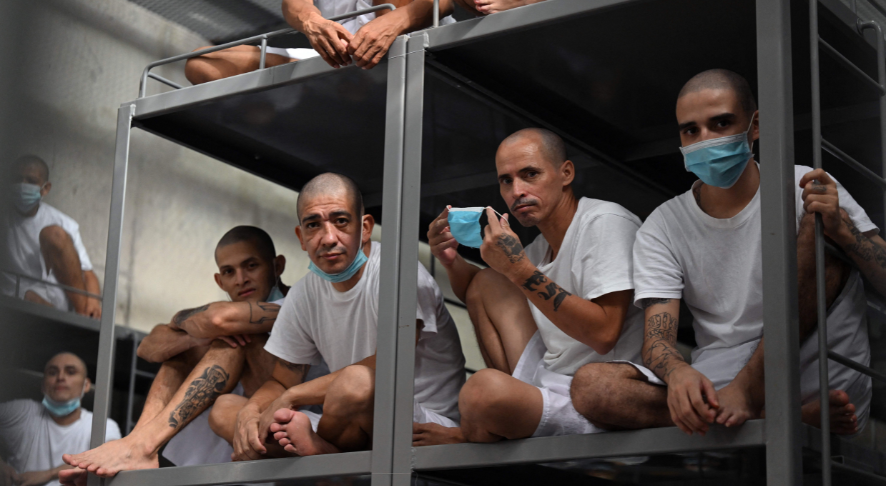
Perhaps the most notable example of such approaches in recent years has been El Salvador. Bukele’s Territorial Control Plan has used mass incarceration as a key tool to dismantle gang control and reduce organised crime. Under Bukele’s leadership, 3% of the country’s adult male population has been imprisoned, with many detainees still awaiting trial. The prison system in the country is overcrowded, operating at 162.8% capacity. Over 80,000 people have been imprisoned since 2022, when a state-of-emergency law took effect.
These policies have significantly reduced homicides, with El Salvador recording 24 consecutive murder-free days in December 2024. However, this ‘success’ has come at a steep price in terms of human rights and the strength of democratic institutions. The Centre for the Confinement of Terrorism, built under Bukele’s administration and considered one of the largest prisons in the Americas, has been criticised for its harsh conditions. With a capacity of 40,000, inmates sleep on metal bunks without mattresses, endure constant illumination and are restricted to one hour of exercise per day. Furthermore, the deterioration of legal and institutional safeguards associated with Bukele’s militarised approach to security poses broader risks to society.
Several other countries in Latin America have taken comparable approaches, with resulting high rates of incarceration. In Guatemala, prisons are operating at an astounding 299.4% capacity. Meanwhile, Honduras’s President Xiomara Castro announced plans in mid-2024 to build a ‘mega prison’ with 20,000 beds, as the country’s penitentiary system struggles at 150% capacity. In Ecuador, following the declaration in January 2024 by President Daniel Noboa of an internal armed conflict against criminal groups, a constitutional referendum saw citizens vote in favour of longer prison sentences, the extradition of violent criminals and stricter counter-narcotics policies. These measures have driven up incarceration rates and contributed to increasing militarisation of the country’s public security. The Ecuadorian prison system is at 120.7% capacity, with Noboa’s 2024 policies yet to be fully reflected in the figure.
Broader implications
Detention facilities themselves have become fertile ground for cartels and gangs to operate and expand, with criminal groups often effectively controlling the penitentiary system. From behind bars, gang members order killings, orchestrate the smuggling of drugs to the US and Europe, and direct kidnappings and the extortion of local businesses. Brazilian prisons, for example, operating at 135.8% capacity, have become headquarters from which organised-crime groups recruit members, control and expand their criminal activities, and project power outside. This has been the case for two of the country’s (and region’s) most notorious non-state armed groups (NSAGs) – the First Capital Command (PCC) and Red Command – which began as prison gangs in Sao Paulo and Rio de Janeiro respectively. The PCC now also controls prisons in Paraguay and Bolivia. In Venezuela, NSAGs control 46% of the prison population, and criminal groups in Mexico fully or partly control over half of the country’s prisons.
Overcrowding and corruption have, on occasion, led to the influence or control of authorities by organised criminal groups. In Ecuador, the disproportionate rate of inmates to guards, in addition to the guards’ low salaries, has resulted in some officials joining the criminal organisations.
Rethinking security approaches
Mass incarceration alone fails to address the complex structural barriers to long-term stability in Latin America. Corruption, both within and beyond prison systems, alongside poor governance standards have proven to be major obstacles to achieving sustainable security and reducing crime. Prison overcrowding, coupled with insufficient government funding for minimal rehabilitation programmes, has exacerbated these challenges.
Expanding debates on alternatives to incarceration, including criminal-justice reform, is therefore critical. Adopting phased approaches that combine immediate crime prevention with long-term systemic reforms can improve outcomes in crime reductions and institutional effectiveness. By addressing the root causes of crime, such as poverty and lack of economic opportunities, these initiatives can, in turn, decrease both incarceration rates and overall insecurity.
The feasibility of implementing such reforms, however, remains contingent on political will, available resources and international cooperation. The region’s security trajectory continues to be shaped by external influences, particularly the United States’ long-standing preference for punitive, enforcement-heavy approaches to crime and border control – an approach that has historically constrained more comprehensive strategies addressing the root causes of violence. The Trump administration’s strict foreign policy towards Latin America has further escalated this trend, pressuring regional governments to implement harsher crackdowns at borders and on drug-related crime. The recent announcements by Trump and Bukele exemplify this deepening reliance on incarceration as a primary security tool, reinforcing harsh punitive measures while limiting opportunities for cooperative security frameworks. As a result, the region risks becoming further entrenched in a cycle of short-term containment strategies rather than pursuing sustainable, long-term security improvements.