
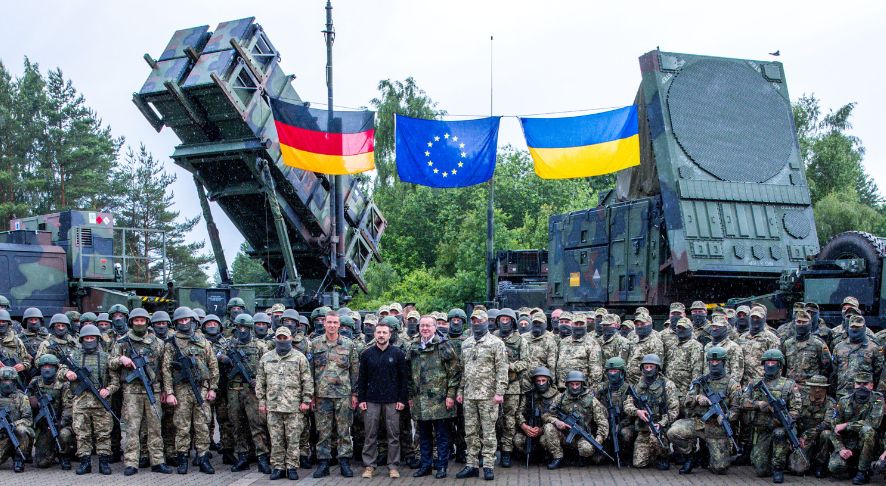
Ukraine’s diverse air defence capabilities have demonstrated resilience against sustained Russian attacks. However, the combination of Soviet-era and Western systems has created interoperability, maintenance and training issues. Delivery numbers and delays from the West have constrained Ukraine’s capacity for air defence
Ukraine’s air defences have proven resilient in countering three years of Russian air and missile attacks and have evolved in response to an ever-changing threat landscape. A key target of these attacks is Ukraine’s energy infrastructure, which, according to reports, is consequently unable to meet demand.
Western donations of air defence systems have enabled Ukraine to adapt, but the continued and increasing supply and support of these systems is critical given Russia’s plan to ramp up the production of missiles and one-way-attack uninhabited aerial vehicles (OWA-UAVs).
President Trump’s recent criticism of President Zelenskyy and the amount of aid the United States has supplied has made the future of continued support at current levels uncertain. Given Ukraine’s reliance on Western aid, any reduction threatens its air defence capabilities, with Zelenskyy having recently raised the issue of shortages of Patriot interceptors.
Evolving inventory
In 2022, Ukraine relied on Soviet-era air-defence systems, mainly the long-range NPO Almaz S-300 (RS-SA-10 Grumble) and medium-range NIIP Tikhomirov 9K37 Buk (RS-SA-11 Gadfly), to counter Russian missile attacks. These involved land-attack cruise missiles (LACMs), such as the air-launched Raduga Kh-101 (RS-AS-23A Kodiak) and the Novator 3M14 (RS-SS-N-30A Sagaris) naval LACM, and short-range surface-to-surface missiles, such as the 9K720 Iskander-M (RS-SS-26 Stone) and 9K79-1 Tochka–U (RS-SS-21B Scarab). But by the end of 2022, Ukraine’s stock of Soviet-era missiles was dwindling and could not be replaced, leaving it with the daunting prospect of depleted munitions stocks.
Ukraine did receive an S-300 battery from Slovakia – the only one donated – followed by a wide array of Western short- and medium-range surface-to-air missile (SAM) systems from European countries and the US. These included legacy systems like the Raytheon MIM-23B I-Hawk, and modern ones, such as the Diehl IRIS-T SLM.

Military Balance+
Military Balance+ | The online defence database from the IISS, delivering authoritative and searchable defence data and insights into military capabilities, policy priorities and commercial opportunities in more than 170 countries.
Additionally, Western partners have taken measures to modify or replace some of Ukraine’s Soviet-era systems. The US adapted some Buk launchers to fire Raytheon’s RIM-7 Sea Sparrow, though Ukraine has not extensively used this stopgap solution, dubbed ‘FrankenSAM’.
The United Kingdom modified the MBDA Advanced Short-Range Air-to-Air Missile for ground launch, using the Supacat HMT 600 as the launch vehicle. To exploit the ample supply of Ukrainian air-to-air missiles, the UK has also retrofitted the infra-red Vympel R-73 (RS-AA-11A Archer), testing a new shipping-container-based system called Gravehawk that is mounted on a Leyland DAF 8×6 Drops truck. Another approach combines Ukrainian air-to-air munitions and launch vehicles. Ukraine’s Come Back Alive Foundation adapted the R-73 for launch with the 9K33 Osa (SA-8 Gecko) to compensate for its dwindling supply of 9M33M3 missiles.
Ukrainian air defence units are a composite of various systems, and the combination of legacy Soviet and different types of Western systems complicates interoperability, maintenance, training and integration into Ukraine’s own structure.

Future challenges
Russian attacks involve the simultaneous use of OWA-UAVs, missiles and decoys in an effort to complicate the interception of threats, deplete munitions stocks and flush out air-defence radars. While Ukraine tries to avoid employing interceptors against OWA-UAVs, these will become a priority for SAMs if they bypass lower-cost defences and approach sensitive targets. A large number of mobile fire teams equipped with small-calibre guns provide point defence, while electronic-warfare units have reportedly made intercepts through jamming and spoofing. Additionally, Ukraine has begun using first-person-view interceptors as a hard kill solution against light intelligence, surveillance and reconnaissance (ISR) UAVs and, to a lesser extent, Zala Lancet OWA-UAVs. With expanded manufacturing capacity for the Geran-2 (Shahed-136), Russia is increasing the number of OWA-UAV attacks and could sustain a rate of over 2,000 systems per month. Furthermore, Russia is working on increasing missile production and has imported the Fath-360 and Hwasong-11A (KN-23) short-range ballistic missiles.
Timely and sufficient deliveries of air-defence systems and munitions to Ukraine are therefore crucial in fending off attacks on critical infrastructure, urban areas, air bases and the front line. Previous delays have repeatedly weakened Ukraine’s air defences.
Between late 2023 and early 2024, Ukraine suffered from a substantial halt in the supply of munitions and systems due to European delays and the holdup of a major aid package in the US Congress. Significant transfers resumed after the NATO summit in July. The Biden administration decided to prioritise deliveries of NASAMS and Patriot interceptors to Kyiv over other countries, indicating that the increase in production does not yet meet the demands of both Ukraine and other operators.
Despite the substantial support received so far and additional systems scheduled for delivery, Ukraine’s air- and missile-defence capabilities remain insufficient amid Russian efforts to sustain or increase their attacks for the remainder of the year.