
America is pre-emptively ceding fundamental and long-held positions to Russia in the hope of ending a war it is not fighting. This is likely to make it less, not more, secure.
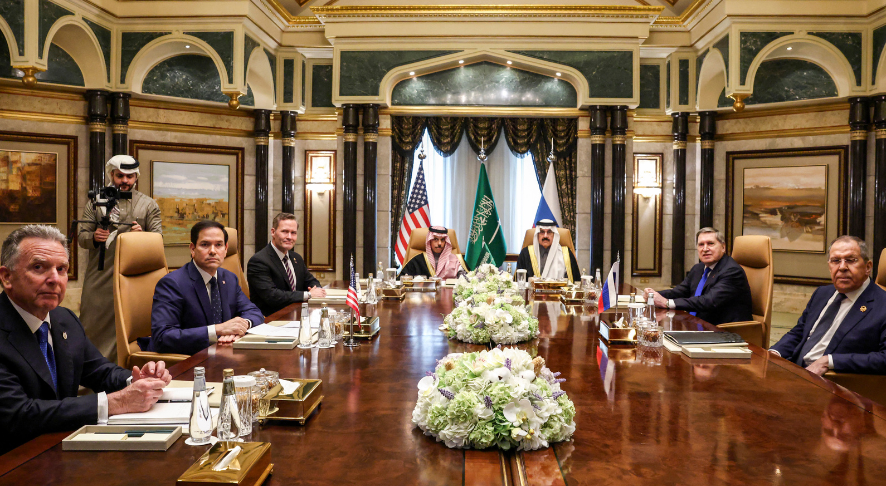
Ten days of diplomacy in Brussels, Munich and Riyadh have laid bare President Donald Trump’s approach to the Russia–Ukraine war. It is a policy of rapid, unilateral concession of long-held positions on fundamental interests to persuade the aggressor to stop fighting. The established name for such a policy – not a polemical but a well-established one – is ‘strategic surrender’. In the classic study commissioned by the United States intelligence community in 1957, this is defined as ‘orderly capitulation … to obtain some political concession’.
This term captures, far better than ‘negotiations’, the dynamics of the US–Russia talks that began last week in Riyadh and are expected to continue in Moscow and Washington. Genuine negotiations involve carrots and sticks: offers that will benefit the other side if it agrees to a desired outcome and threats to impose costs if it does not.
America is using little of either. It is instead accepting a series of escalating Russian demands without extracting any quid pro quo except the promise of an end to the war on terms that Russia dictates. In doing so, America has reversed a series of fundamental positions. Having isolated and constrained Russia, it is normalising their relations and exploring new trade and investment opportunities. Having given Ukraine military and financial help to defend itself, it has announced the end of aid, and reportedly threatened to cut the essential Starlink satellite link while demanding access to mineral wealth on onerous terms. Having pledged to protect Europe for eighty years, it is scaling back its protection to a smaller, unspecified and increasingly doubtful commitment. Vice President J.D. Vance has raised the possibility of troop withdrawals from the continent – a demand that Russia has reportedly already made.
Russia, by contrast, has ignored the few requests that America is known to have made. When US officials asked Russia to suspend attacks on Ukrainian energy facilities before talks began, their counterparts claimed that no such attacks were taking place. Russia has also categorically rejected the deployment of foreign forces in Ukraine, despite Secretary of Defense Pete Hegseth’s suggestion that ‘European and non-European troops’ could be deployed as ‘peacekeepers to Ukraine’.
The baffling urgency for a deal
America’s extreme and undisguised urgency is also characteristic of strategic surrender rather than typical end-of-war negotiations. It predictably strengthens Russia’s position even further. In his book, The Art of the Deal, Trump wrote, ‘the worst thing you can possibly do in a deal is seem desperate to make it. That makes the other guy smell blood, and then you’re dead’. This is precisely what Trump is doing, and the consequences are just as he describes, enabling Russia to steadily raise the price it extracts for agreeing to stop fighting.
Putin has been very clear what this price is. His ambitions go far beyond the subordination of part, or even all, of Ukraine. They extend to establishing a dominant position in a new European security order defined on Russia’s terms. This vision was set out in two draft treaties that Russia presented to America and NATO in December 2021 that demanded, among other measures, the withdrawal of NATO forces to its 1997 borders and of American nuclear weapons from Europe. Putin envisages the formation of ‘a completely new world order … unlike what we know from the past, for example, the Westphalian or Yalta systems’.
While America cannot ‘negotiate’ – especially with only one side – an end to a war it is not fighting, it could instead have tried to mediate such an outcome. This would involve offering the victim, Ukraine, security guarantees to accept a compromise, and restraining the aggressor, Russia, with the threat of escalating sanctions and further support to Ukraine. In its first week, the Trump administration hinted at such a strategy, threatening severe economic pressure on Russia through new sanctions and lower oil prices. It is now doing the opposite: constraining Ukraine, publicly refusing either to provide or protect any forces that might guarantee a peace agreement, hinting it may ease sanctions on Russia, and agreeing to talks in Saudi Arabia – a country that adamantly opposes lower oil prices.
The puzzle of America’s interests
Strategic surrender has always been a policy adopted by states facing total defeat and occupation. Since America is vastly superior to Russia, and faces no such danger, its decision to do so is puzzling. Three further factors compound this.
Firstly, while Trump promised to end the war quickly during his election campaign, there is no evidence that doing so by siding with Russia is popular with American voters. Only 30% say America is giving too much support to Ukraine.
Secondly, the administration has not clearly articulated why its approach serves American interests. Trump has called the conflict a ‘terrible war’ that has killed ‘millions’, and senior figures say it is ‘bad for America’. But none has set out in any detail the benefits of ending it as soon as possible, on terms highly favourable to Russia. Alone among the administration’s policies, this one lacks a clear rationale in terms of core national interests.
Thirdly, this approach is in fact likely to harm America’s long-term security. It will not only imperil Europe, its biggest trade and investment partner, but will make Russia a more powerful, assertive and attractive ally to America’s adversaries around the world.
This is especially true of China. Some in Washington argue that America can conduct a ‘reverse Kissinger’ that detaches Moscow from its quasi-alliance with Beijing. The analogy is historically uninformed and strategically illiterate. When America established ties with China in 1972 to help contain the Soviet Union, relations between Beijing and Moscow were already extremely poor – the two had fought a border war only three years earlier. Today, by contrast, they are unprecedentedly close. The concessions that America grants Russia in Europe will not induce it to curtail highly beneficial cooperation with China, but merely enable it to negotiate this on more favourable terms. Russia could thus secure a privileged position in a new strategic triangle, enjoying better relations with the US and China than they have with one another.
Other countries have chosen strategic surrender to avert disaster in dire military weakness. America has initiated a diplomatic version from a position of great strength. If it continues on this course, it will become less secure. The reason America has chosen it is profoundly mysterious.